Intent in.
Software out.
HydraFlow is a delivery kernel for GitHub repositories:
it accepts intent, compiles it through a staged pipeline,
enforces quality gates, and produces merged software changes.
It scales your workflow, not just your output.
Turning your repository into a programmable delivery engine powered by your hooks and skills.
This is Harness engineering at scale!
Everything you need for autonomous development
From issue triage to merged PR. A complete pipeline of specialized AI agents working in concert.
Multi-Provider Agent Fleet
Runs Claude and Codex CLI agents in Docker containers with git worktrees, slash commands, and hooks. Full isolation per agent, with automatic failover to a backup model provider when credits run dry.
Repo Prep
Ensures tests, CI, linting, and other hygiene processes are in place. HydraFlow leverages your existing quality gates to guarantee accurate, high-quality output.
Autonomous Triage
Full TriagePhase with title/body quality checks, duplicate detection, and manifest analysis. Auto-detects languages, build systems, test frameworks, and CI before promoting.
Intelligent Planning
A read-only agent explores your codebase, understands architecture, and posts a detailed implementation plan as an issue comment.
Automated Review
A dedicated review agent checks correctness, style, and test coverage, then submits formal GitHub PR reviews. Judges are calibrated against a ledger of escaped defects, so review quality is measured, not assumed.
CI/CD Integration
Monitors CI checks in real-time. Automatically retries on transient failures and auto-merges approved PRs when all checks pass.
Two-Tier Release Train
PRs merge to a staging branch. A promotion loop cuts release-candidate PRs to main on a fixed cadence, gated by a full regression suite — so main stays green while agents ship all day.
Human-in-the-Loop
When agents hit walls (ambiguous requirements, failing CI, hard merge conflicts) issues escalate to hydraflow-hitl for human guidance. You stay in control.
Agent Memory
Agents learn from past runs. A persistent memory system with digest compaction extracts patterns and feeds them back into future sessions.
Crash Recovery
JSON-backed state persistence tracks every in-flight issue. If HydraFlow restarts, it picks up exactly where it left off. No lost work.
Merge Conflict Resolution
A dedicated MergeConflictResolver uses agent-assisted fixing to resolve conflicts automatically. Only hard conflicts escalate to HITL.
Caretaker Loop Fleet
65 background loops keep the factory healthy while nobody watches: PR unsticking, worktree GC, flake tracking, branch-protection audits, ADR drift resolution, and fitness scorecards for the loops themselves.
Metrics & Cost Analytics
Cycle time, success rates, and throughput — plus per-loop LLM cost attribution and budget watchdogs, so you always know what the factory spends and where.
Post-Merge Retrospective
After merge: acceptance criteria verification, retrospective analysis, epic progress checking, and structured learning extraction.
Self-Documenting Architecture
125 Architecture Decision Records, a 300+ entry repo wiki kept fresh by its own loop, and an auto-generated system map republished every four hours and on every PR.
How it works
A label-driven pipeline that takes an issue from discovery to a released change on main.
You + Claude
File an issue with context. Claude scans for duplicates.
Orchestrator
Evaluates readiness and promotes labeled issues
PlannerRunner
Explores codebase, posts implementation plan
AgentRunner
TDD implementation in isolated worktrees
ReviewRunner
Code review, CI monitoring, fixes
Auto-merge
Approved PR merges to staging when CI passes, with human UAT criteria attached
RC train
A promotion loop cuts regression-gated release candidates from staging to main
Human-in-the-Loop
CI failures or ambiguity escalate to hydraflow-hitl
You + Claude
File an issue with context. Claude scans for duplicates.
Orchestrator
Evaluates readiness and promotes labeled issues
PlannerRunner
Explores codebase, posts implementation plan
AgentRunner
TDD implementation in isolated worktrees
ReviewRunner
Code review, CI monitoring, fixes
Auto-merge
Approved PR merges to staging when CI passes, with human UAT criteria attached
RC train
A promotion loop cuts regression-gated release candidates from staging to main
Human-in-the-Loop
Escalates when agents need help
See it in action
Watch an issue flow through the entire pipeline, from triage to merged PR.
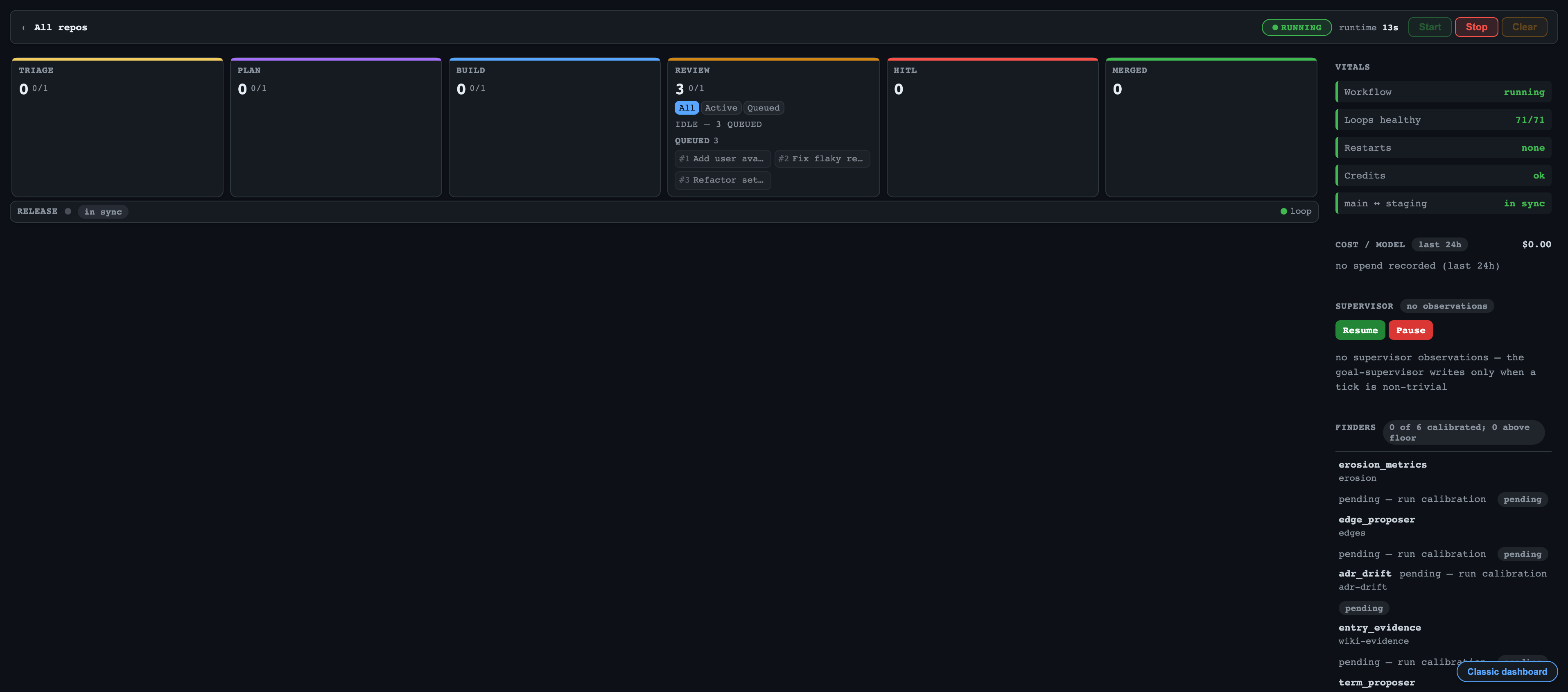
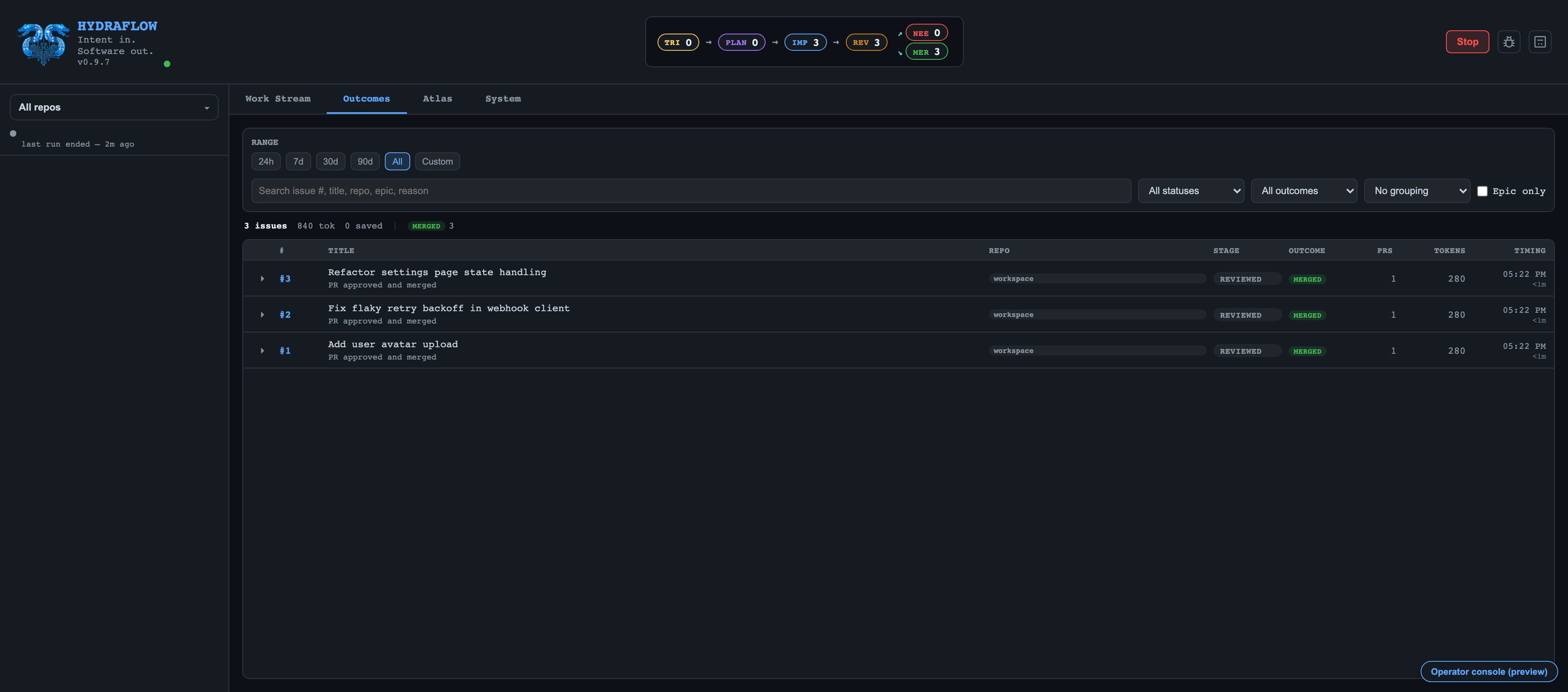
The dashboard
Real-time visibility into every issue, agent, loop, and pipeline stage.
Work Stream
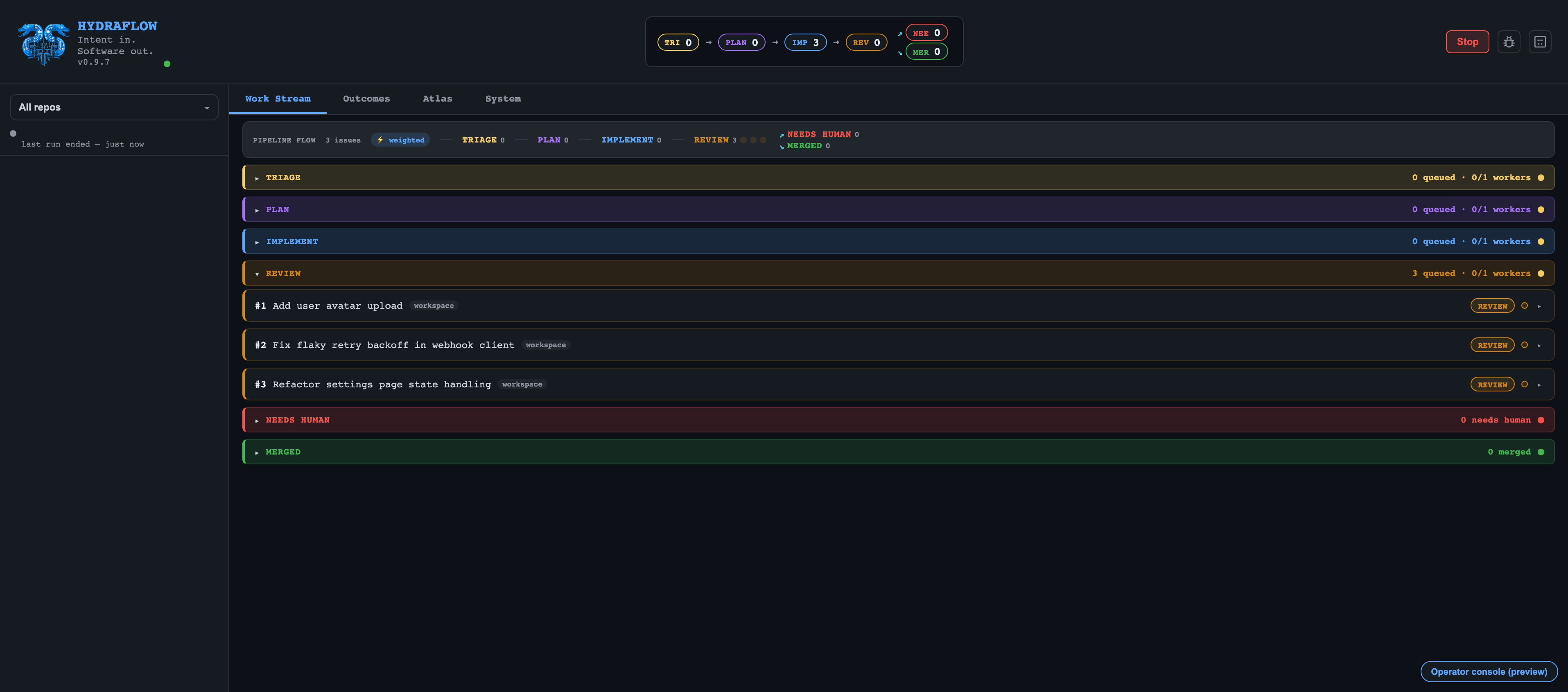
Operator Console
Outcomes
System Workers

HydraFlow builds HydraFlow
Every feature, bug fix, and improvement to HydraFlow is triaged, planned, implemented, and reviewed by its own agents — 8,000+ issues and 2,400+ merged PRs into its own repository so far.
Its agents even document it: the live architecture site is regenerated from the code every four hours and on every PR.
Get started in 3 steps
From zero to autonomous development in under 5 minutes.
Clone & Run
git clone https://github.com/T-rav/hydraflow.git
cd hydraflow

# Bootstrap .env, git hooks, and labels, then start
# the backend + dashboard at http://localhost:5556
make setup
make runConnect Your Repo
# In the dashboard, use "+ Add repo" to register the project
# HydraFlow should work on — or do it from the terminal:
curl -X POST "http://localhost:5556/api/repos/add?path=/path/to/your-repo"File an Issue
# In Claude Code, create an issue with HydraFlow's integrated slash command.
# It searches for duplicates, logs big issues as epics, and tags the issue for delivery.
/hf.issue "make the text pink"

# Agents take it from there: triage, plan, implement, review, merge.